
The smell of salty French fries was unmistakable as locals ventured into Pinder’s Lunch on Lindsay Street North one summer’s day in 1941, wooed by a clever advertisement in the local paper. “One of the best meals served in town for 25¢,” they read. “Fish and Chips that are always fresh, hot, and greaseless. Cooked the modern way. Served at all hours.”
Cooked in Crisco, the famous brand of shortening, D. J. Pinder and Howard St. John’s product may not have been the healthiest option in town – but it was an affordable one at a time when memories of the Great Depression were still fresh. Moreover, those who lined up at Pinder’s 85 years ago were surely enticed by the prospect of not having to do the cooking themselves for a change.
That, after all, has always been one of the attractions of eating out – not least in globally-recognizable chain restaurants that trace their origins to the consumerism and optimism of postwar North America. Long before the golden arches of McDonald’s and its various culinary competitors made their presence felt in this area, the humble fish and chip shop, together with independently owned and operated roadside snack bars, were the purveyors of what we today call fast food.
Nearly 100 years ago, a business calling itself the Ideal Fish and Chip Shop was offering takeout options from its location at 32 Lindsay Street South. “Those who desire large orders to take away are requested to phone them before calling,” noted an ad from 1928. The fish and chip business grew following the Second World War, with other entrepreneurs setting up shop in the general vicinity of Lindsay Street – no doubt on account of it being one of the principal thoroughfares leading into town.
Those who lined up at Pinder’s 85 years ago were surely enticed by the prospect of not having to do the cooking themselves for a change.
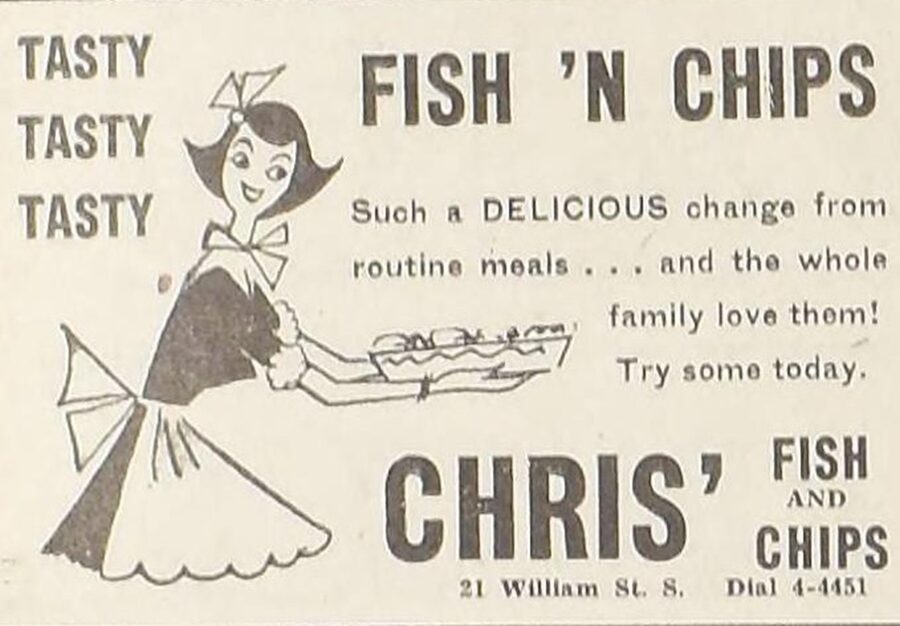
Among the best-known of these businesses was Chris’s Fish and Chips, which was located at various addresses in the south ward during the 1950s and 1960s. Chris Grazos famously wrapped up his fare in newspaper until approximately 1968, when the business became known as Pelican Fish and Chips under the proprietorship of Clarence Adams. (The Adams family’s culinary legacy is carried on to this day by Darryl Adams, owner of Terry’s Fish and Chips, which his brother began in 1979.)
Just as fish and chips grew in popularity from the 1920s into the 1940s, so too did the family car, and the fast-food scene in Kawartha Lakes has long been inextricably connected with the prevalence of automotive-focused tourism. Snack bars, often operated in conjunction with roadside service stations, popped up along increasingly busy highways crisscrossing the county.
Margaret Valentine’s family ran a snack bar at Coboconk’s British-American gas station more than 75 years ago. “During the war, there was no pop – sugar rationing was in effect,” Margaret recalled in a 2022 interview. “We mixed orange concentrate and sold it by the paper cup for 5 cents. We [also] sold breakfast, sandwiches, hamburgers, hot dogs, and the best home-made pie ever.”
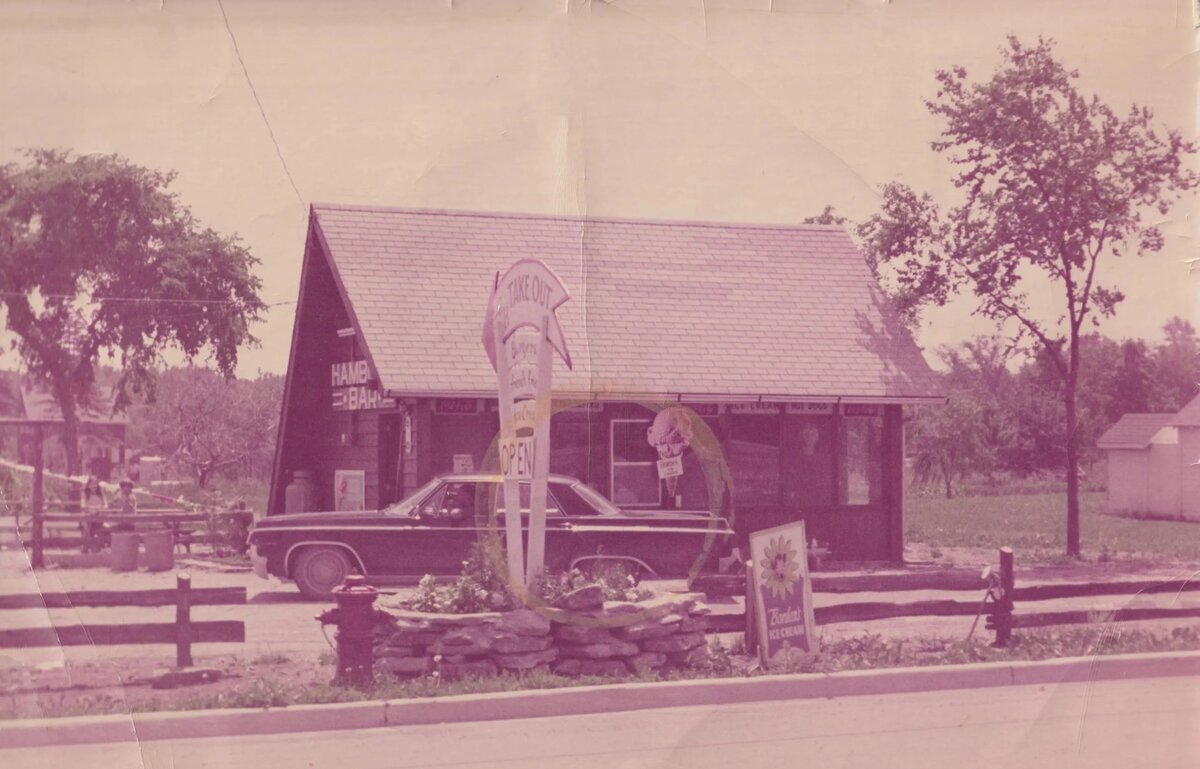
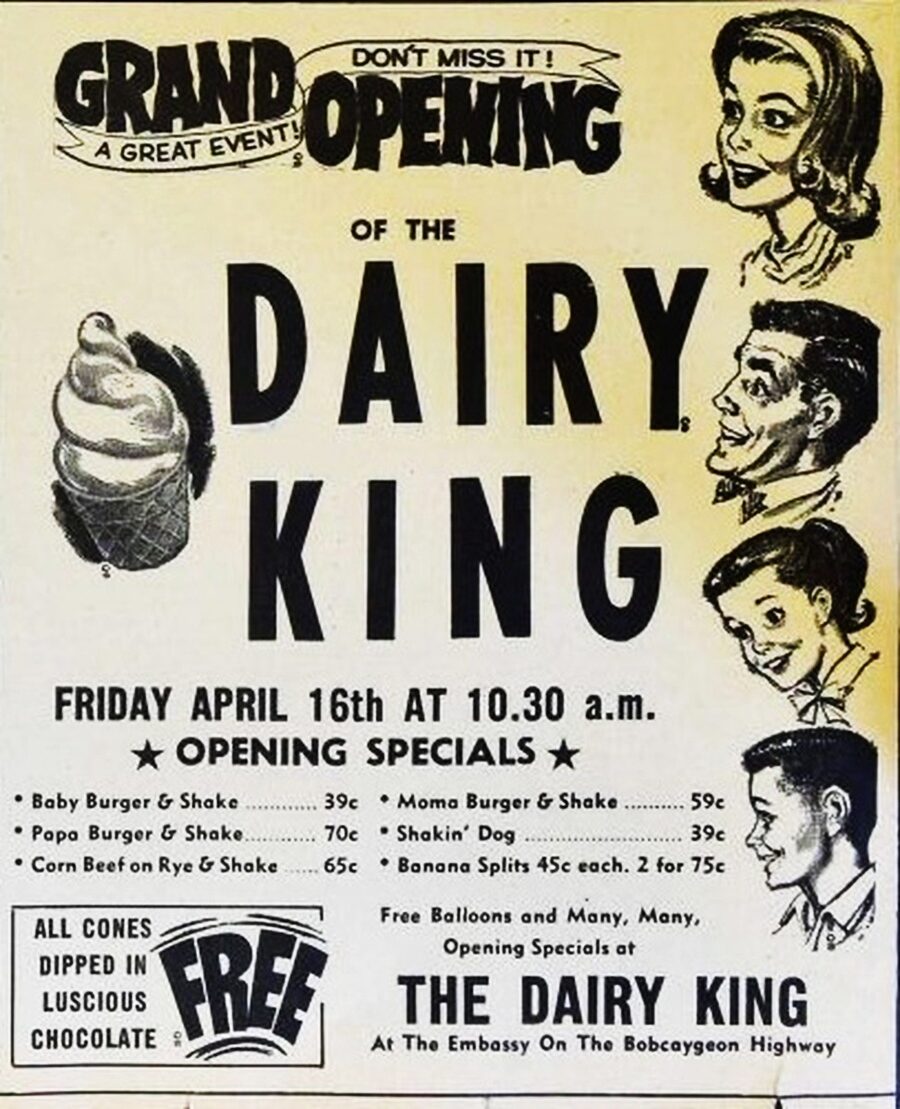
Other snack bars dealing in traditional fast-food items included the rustic-looking Club Balsam in Rosedale, Henry Sternberg’s Hamburg Bar in Fenelon Falls, and the short-lived Dairy King, which was located at the Embassy dance hall on County Road 36, just east of Lindsay. Starting in 1965, Dairy King was advertising a “Papa Burger,” a “Moma Burger,” and a “Baby Burger,” all of which could be purchased with a milkshake for 70¢, 59¢, and 39¢, respectively.
Two years later, Dairy King had rebranded its mainstays as King, Queen, and Princess burgers – perhaps to avoid confusing its “burger family” with that of A&W, which originally opened in 1965 just east of the Kent and Albert Street intersection. A&W, like the roadside snack bars, was designed especially with the private automobile in mind. Female servers, known as car hostesses, were hired to bring orders of hamburgers, fries, and root beer to consumers waiting outside. According to an advertisement placed in Peterborough and Lindsay papers at the time, car hostesses “must be 5’ to 5’ 6” tall, size 10-16, neat, courteous, accurate and presentable to the public, married and single.”
The fast-food scene was growing. Colonel Harland Sanders made an appearance in Lindsay to open a Kentucky Fried Chicken franchise at Foster’s Chicken Villa on Lindsay Street South, in 1968. And in 1977, history was made when McDonald’s opened its very first Canadian drive-through restaurant in Lindsay. Sporting 146 seats, and overseen by general manager George Wright, McDonald’s heralded a new era on Kent Street West. By the first decade of the 21st century, most of Lindsay’s fast-food franchises, including KFC and A&W, had relocated to that part of town.
Snack bars, often operated in conjunction with roadside service stations, popped up along increasingly busy highways crisscrossing the county.
Despite the dominance of multinational corporations, family-owned operations – such as Deighton’s chip truck, owned by MaryJane Herlihey’s parents – remained ubiquitous. “Starting I think in the late 60s, they began parking it on the corner of Kent and Victoria on the weekends,” Herlihey recalls. “When Weldon opened, they parked it at their house on Weldon Road and opened only at lunch for the students.” The Deightons served long lines of hungry students, and business was brisk.
Though that chip truck is no more, local entrepreneurs and large chains alike will continue to satisfy our cravings for fast food. Pass the ketchup, please.

Leave a Comment
Your email address will not be published. Comments are moderated.